

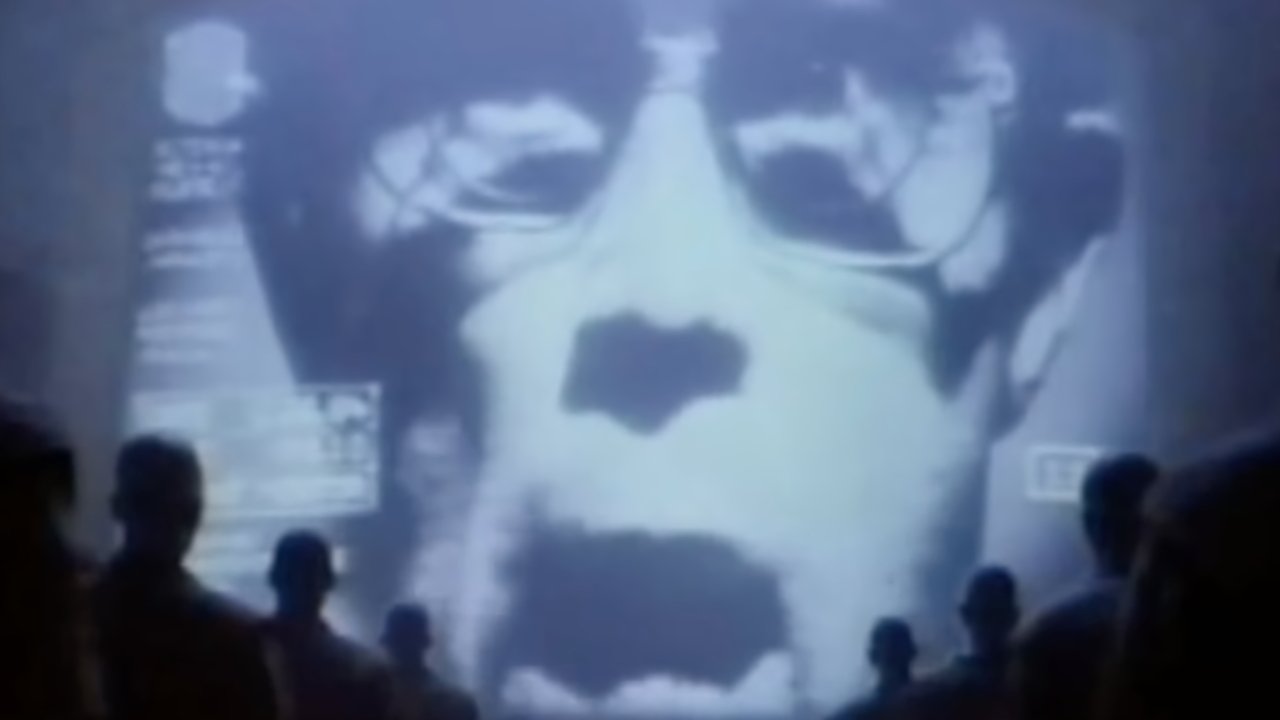
It’s lauded as one of the most effective ads ever made, it stunned viewers, but on January 22, during the Super Bowl, “1984” launched the Macintosh without even showing the product once. It almost didn’t make it to air.
This ad is so famous that you know how it goes. An athlete in full color, runs through a gray room full of gray people and she throws a sledgehammer to smash a gray screen.
All of that gray is down to George Orwell’s Big Brother — or as close as could be without paying royalties — and this spark of color represents the Macintosh.
“On January 24th, Apple Computer will introduce Macintosh,” said a text crawl at the end. “And you’ll see why 1984 won’t be like ‘1984’.”
Macintosh. Nobody outside of Apple or perhaps the technology press had heard of it — and even those who knew the name, probably didn’t rate its chances.
This was 1984, three years into the enormous, overwhelming success of the IBM PC. Apple’s famous Apple II computer was showing signs of running out of steam — although its developers wouldn’t appreciate you saying that. The world was choosing Commodore and MS-DOS because they were cheap.
Steve Jobs with an Apple Lisa
Plus everything you think of with the Mac, from a mouse to a graphical screen not very dissimilar to what we have today, that actually was known. It had been released by Apple in the form of the Lisa the year before.
It had been released, but then just about ignored because of its $10,000 price tag. PCs were still expensive compared to what they cost today, but $10,000 in 1983 is around $32,500 in 2026, so, far more than twice the cost of the even most expensive current Mac Pro.
Reputation and baggage
Apple had its fans. They had reason to be fans, but you can only enthuse so much. If people were aware of the reasons to buy Apple, they were also aware of the cost of it, and those two facts were inextricably linked.
And again, only if you were just aware of Apple at that time. You were certainly aware of IBM. There is a case to be made that the point of the “1984” ad was to make people perceive Apple and IBM as the only two players.
It was a perception worth pursuing, but it cost Apple dearly.
According to the 2004 book, “Apple Confidential 2.0” by Owen W. Linzmayer, in 1984 it cost Apple $500 to make each Macintosh on the production line. To be more specific, it was $415 in parts, $5 in labor, and $80 in unspecified overheads.
This is Apple, so it was never going to sell the Mac for $501. Linzmayer claims that at that time, the typical Apple markup would have made it $1,995.
That sounds right to us. Our Managing Editor, Mike Wuerthele worked in an Apple dealership at the time. The margins for the dealers was about 35%, and there was no way that Apple was taking less for itself.
Instead, it sold for $2,495 — and every bit of that $500 more was because of advertising. Apple CEO John Sculley spent as much on advertising as it cost to make a Macintosh.
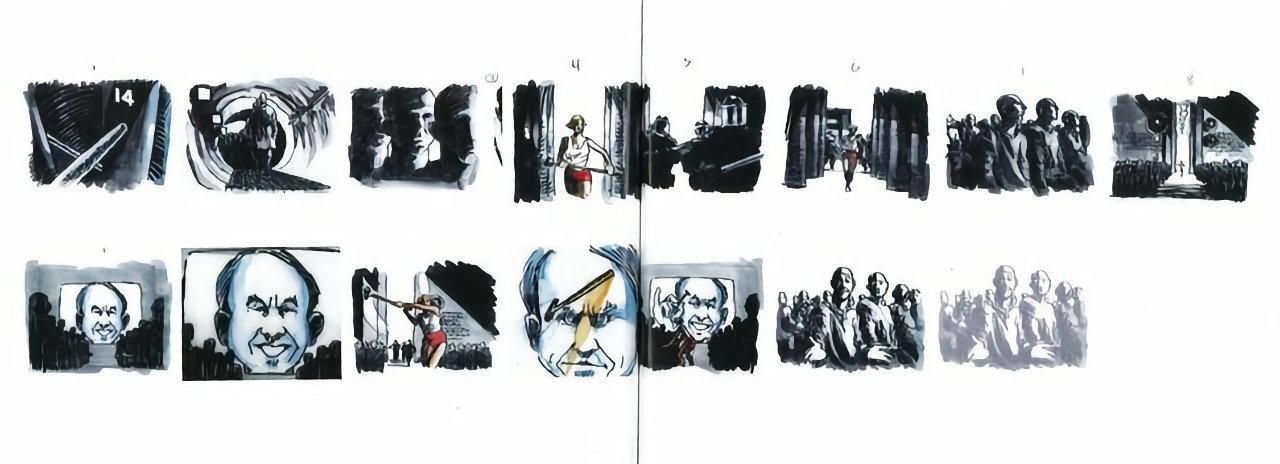
Part of the original “1984” pitch deck that sold Steve Jobs on the idea — image credit: Apple
The “1984” ad was only the start of what, to be fair, was intended to be a 100-day mass-market saturation of advertising. And saying it was $500 per Mac is an estimate, but it’s the same estimate Sculley made when he authorized spending $15 million on the campaign.
He calculated that the $500 extra on the price would pay back the $15 million once Apple had sold 30,000 Macs. By April 1984, it had sold 50,000.
Of all the advertising Sculley bought with that $500 price increase, though, none was more expensive than the “1984” Super Bowl ad. Ultimately none was more effective too, but then none of the rest of it came so close to being cancelled before it was made.
Putting together “1984”
Not to spoil how this ad and the Mac are so inextricably linked, but ad agency Chiat/Day wrote “Why 1984 won’t be like ‘1984’” for the Apple II. It wasn’t used, and really it was only the start of what the ad would become, but it predated the Mac by six months.
What also predated the Mac was Chiat/Day’s research into the attitude and usage (A&U) of consumers. According to the book “West of Eden” by Frank Rose, Chiat/Day learned that Apple was seen as a young company used by creatives, while IBM was bureaucratic and conservative.
They concluded that “IBM is what people think they ought to be, but Apple is what people feel they’d like to be.” To exploit this, the ad agency had prepared multiple ideas for advertising both the Macintosh and the Apple III.
We’ll talk about the Apple III soon enough. That was a disaster in itself.
Anyway, Clow and Jobs wanted something huge for the first announcement of the Mac. You know where this is going: yes, they wanted an ad called “King Kong Gates.”
It would have had these very large gates, and at the beginning, just a few people would be able to squeeze through. Then the new computer would burst through the gates, followed by thousands of people.
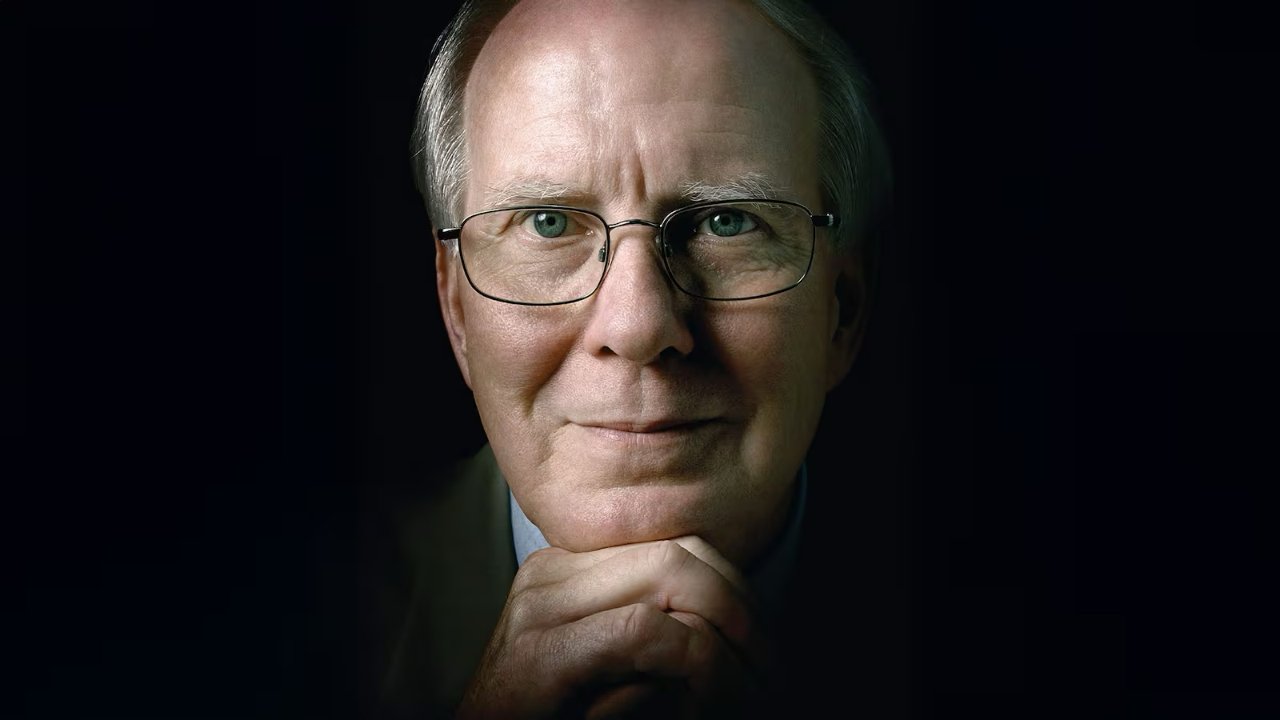
The “1984” ad was written by Steve Hayden — image credit: Ogilvy
Reportedly it was that last part that killed the idea — there was no budget for that many people. And back then, no CGI to fake it.
Whereas there was a budget for what would ultimately become the 200 people in the “1984” ad. Some were already skinheads — a pejorative British term for shaved-head and possibly violent person — and others were paid $125 to shave off their hair.
Steve Jobs adored the idea for “1984.” John Sculley was more wary. The production was ultimately given the go-ahead, though, to be shot in London by Ridley Scott.
Writer Steve Hayden wrote the script, and then director Scott interfered. Scott wanted the face of Big Brother to have spoken dialogue and reportedly threatened to write the lines himself if Hayden didn’t.
Reconsidering “1984”
Once it was finished, Chiat/Day loved the ad, Steve Jobs loved the ad, and John Sculley… wasn’t so sure. At least, he wasn’t until October 23, 1983, which is when the first semi-public screening of the ad took place.
It was at Apple’s annual sales conference, and the reception was ecstatic. All that had to happen now was for Apple’s board of directors to approve it — and they didn’t.
“Most of them felt it was the worst commercial they had ever seen,” said Sculley. “Not a single outside board member liked it.”
It’s unclear quite what happened next as the board either didn’t ask for the ad to be dropped, or it didn’t have the power to. Sculley caved in anyway.
Alongside the $900,000 production cost, the expense of the ad was down to buying the air time and there was still a chance to save some money there. Apple had bought 90 seconds of advertising time at the Super Bowl — 60 seconds for the first, full-length showing, and then another 30-second version to be shown later on.
By then it was very late to sell off an ad, but Chiat/Day was asked to. It did sell off the 30-second slot, but it didn’t even try with the 60-second one, it wanted to make Apple run the ad.
Even then, Apple could still have blown it. Sculley wimped out of deciding whether to run “1984” to fill that slot they had committed $800,000 to. He told Apple’s marketing executives to make the decision — and if necessary to fill the slot with the comparatively safe “Manuals” instead.
“Manuals” worked on the idea that you need manuals to run an IBM PC, but barely a pamphlet for the Macintosh. But it was an ad, it had already been made, and most important of all, it was the right length.
Jobs lobbied hard, Steve Wozniak even offered to pay half the $800,000 if that was the problem. And the two marketing executives, William V. Campbell and E. Floyd Kvamme decided to run it.
The “Manuals” campaign eventually was resurrected for the iMac. Jeff Goldblum narrated it in the famous “there is no step three” ad for the iMac, 15 years later.
The cheapest, most expensive ad ever
So Apple ran its full 60-second version of “1984” during the Super Bowl that year. It did not run its 30-second cut then. Or ever.
Apple never had to buy airtime for its “1984” ad ever again. Because the reaction was so enormous, the response was newsworthy.
The “1984” ad was played in its entirety on news shows around the country. It was played often, it was examined and discussed, and Apple didn’t have to pay a cent more for this incredible exposure.
Advertising isn’t enough
Looked at as a production, as short film, then “1984” is immensely successful. As an advert, it won the 1984 Clio Award.
It later went on to win the Grand Prix at the 31st Cannes Lions International Advertising Festival. And in a retrospective, Advertising Age would ultimately call it the 1980s “Commercial of the Decade.”
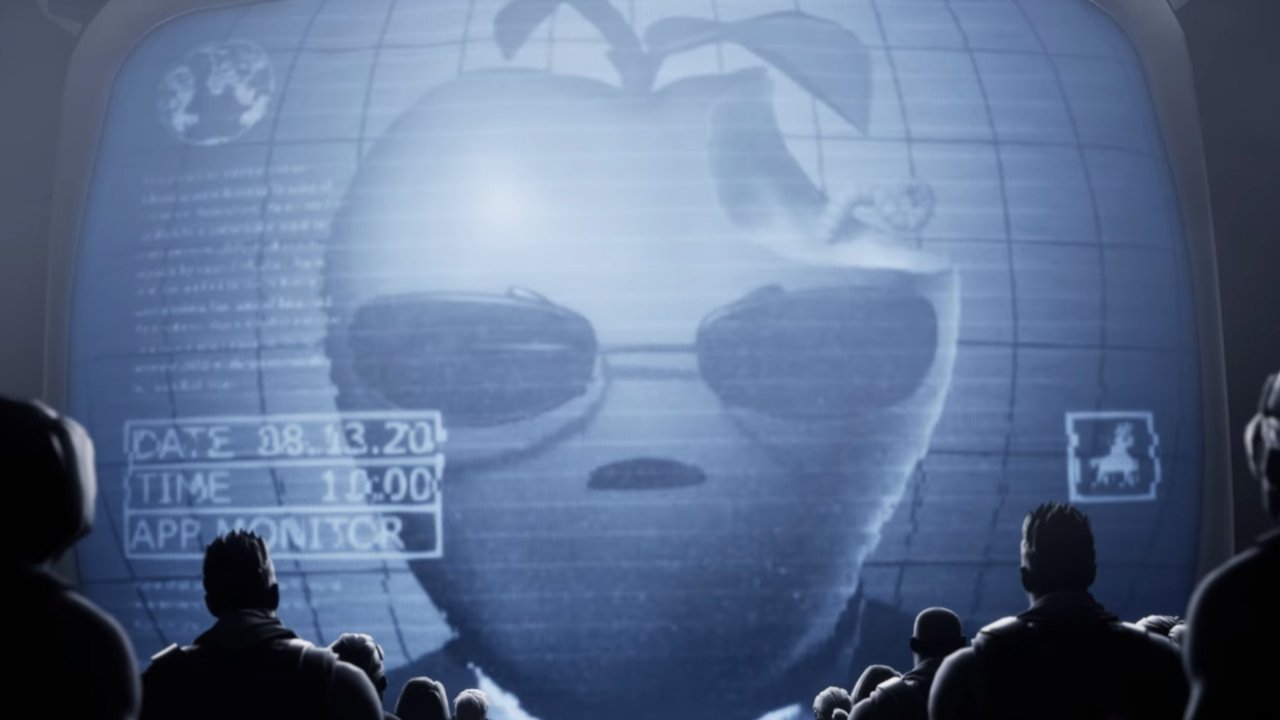
Nearly 40 years later, Epic Games made a pastiche of “1984”, knowing audiences would get it. Image credit — Epic Games
Yet even in the midst of all this success, Steve Jobs had no illusions about what even extraordinary advertising could do.
“Ad campaigns are necessary for competition; IBM’s ads are everywhere,” he told Playboy in 1985. “But good PR educates people; that’s all it is.”
“You can’t con people in this business,” he continued. “The products speak for themselves.”

